Diagnosis notes · updated June 13, 2026
Sub-Zero Compressor Running Constantly: What It Means
Open the kitchen at midnight and the hum is still there. A Sub-Zero® that never cycles off is not simply getting old — it is compensating for something, and the something is almost always findable in a single visit.
A Sub-Zero that runs without pause is working against a handicap — most often a condenser matted with oak pollen and pet hair, sometimes a slow refrigerant leak. In Ortega and Avondale we clear airflow faults for $250 to $550; sealed-system causes run $1,500 to $3,000.
For vintage Sub-Zero repair in Ortega, Avondale, and Riverside, call the shop at (904) 893-3248 or Book online .
(904) 893-3248 · Tue–Sat · 8:00 am–6:00 pm · you reach the bench, not a call center
Why an old Sub-Zero stops cycling off
The compressor’s whole job is to reach set point — 38°F in the refrigerator, 0°F in the freezer — and then rest. When it cannot get there, the cold control or board never opens the circuit. Five faults account for nearly every constant runner that reaches our bench:
- A blanketed condenser. Under Ortega’s live oaks, pollen strings and pet hair felt themselves into a wool blanket over the coil. The system sheds no heat, so it never stops trying.
- A failing condenser fan. On 500 and 600 series machines the fan motor bushings dry out with age; airflow collapses even across a clean coil.
- A slow refrigerant leak. The textbook case is the model 561’s fridge-side evaporator — a frost stripe only four to eight inches wide while the compressor runs itself ragged.
- A worn cold control or drifting thermistor. The machine either believes it is warm when it is not, or truly never reaches temperature.
- Hardened door gaskets. River humidity ages the rubber years ahead of schedule, so the box leaks cold around its own door all day long.
What round-the-clock running costs the machine
Nothing about constant running is free. Head pressure climbs, the oil runs hot, and valves and bearings wear at a pace the engineers never intended. On 600 series units the board keeps count: boards built between 1998 and 2002 will eventually raise the “vacuum condenser” warning once compressor run time goes excessive.
The harder arithmetic is this: a $250 to $550 airflow service, ignored for a season, can finish off a marginal compressor — and a compressor swap on a vintage unit runs $1,000 to $2,000. The earlier the call, the smaller the invoice.
| What you notice | First check | Likely repair lane |
|---|---|---|
| Runs constantly, both compartments holding temperature | Condenser coil and fan airflow | $250–$550 cleaning or fan motor |
| Runs constantly, refrigerator side slowly warming | Evaporator frost pattern — a short stripe means a leak | $1,500–$3,000 sealed-system work |
| Runs constantly, display shows double dashes | Control board EEPROM | $550–$1,100, board stock permitting |
| Runs constantly after a storm outage | Restoration-surge damage to board or relay | $550–$1,100 once the part is confirmed |
What we do in the first twenty minutes on arrival
A constant runner is one of the more satisfying calls because the evidence is orderly. We work it the same way every time, cheapest cause ruled in or out first:
- Read both compartments against 38°F and 0°F — are they holding while it runs, or losing ground?
- Pull the lower or upper grille and look at the condenser; under the Ortega oaks a felted coil is the single most common answer.
- Check the condenser fan by hand and by amp draw — dry bushings imitate a dirty coil exactly.
- Confirm the gasket grips a slip of paper all the way around; a sweating seal means the box is leaking its own cold.
- Only if the refrigerator side is warming do we lift the evaporator cover to read the frost stripe — the one test that separates a leak from everything cheaper.
Four of those five steps cost nothing in parts. That order is why most constant-running calls in Ortega and Avondale close in the $250 to $550 lane rather than the sealed-system band.
How the bench confirms the cause
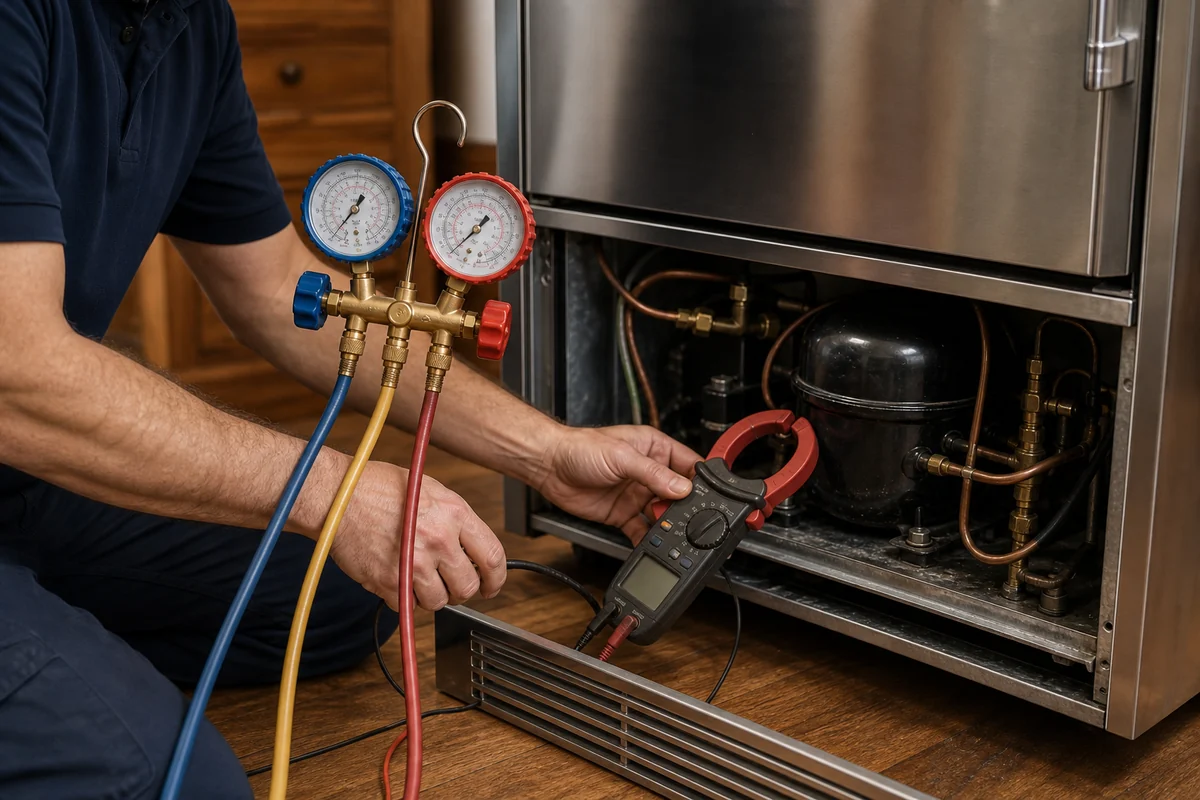
We start with a thermometer, not gauges. Compartment temperatures get read against the 38 and 0 degree set points, compressor amp draw gets compared to the nameplate, and the condenser comes out into the light for inspection. Then the evaporator frost pattern tells its story — full, even frost says the refrigerant charge is healthy; a short partial stripe says it is not.
Only when the evidence points refrigerant-side do we open the system, and only after you have a firm quote for the sealed-system repair in hand. Everything shallower than that — controls, fans, airflow — falls under ordinary refrigerator service and is usually finished the same visit.
The Ortega pattern: oaks above, river beside, old wiring behind
Our neighborhood works against these machines in three particular ways. The oak canopy that shades Ortega Boulevard and McGirts drops pollen and debris that find every condenser intake. The river air keeps gaskets damp and ages them early — worth a look at our gasket replacement notes if your door no longer grips. And the original electrical panels in houses from the twenties and thirties pass along every spike from Northeast Florida’s hundred-plus thunderstorm days a year.
That last one matters more than owners expect: when power returns after an outage, the restoration surge can run 50 to 100 percent over nominal voltage for a moment — long enough to scramble a relay or a board and leave a compressor running with no one at the controls.
What else the running usually travels with
Constant running rarely arrives alone. The companion symptom often narrows the cause faster than the running itself, so it is worth noticing what else the machine is doing.
| Runs constantly, and also… | What the pairing suggests | Where to read more |
|---|---|---|
| warm condenser area, hot kitchen behind the unit | Blocked coil or dead condenser fan | Airflow service, $250–$550 |
| refrigerator side creeping warm, freezer fine | Fridge-side evaporator leak, the 561 weakness | The 561 leak page |
| a “vacuum condenser” message on the panel | 600 series board flagging excessive run time | The warning explained |
| warm overnight after a recent storm outage | Restoration-surge damage to board or relay | Board work, $550–$1,100 |
If the second clue is a refrigerator going warm rather than holding, the more complete walk-through lives on our not-cooling diagnosis for Ortega Forest.
Asked at the bench about constant running
Is it normal for an old Sub-Zero to run more during a Jacksonville summer?
Longer cycles, yes — a warm kitchen with river humidity makes any refrigerator work harder, and a thirty-year-old machine has lost a little efficiency besides. What is never normal is a compressor that fails to cycle off overnight. If the hum is still constant at two in the morning, something is wrong, and finding it early is the cheap option.
Will a compressor that never stops eventually destroy itself?
Often, yes. Continuous running on a starved or airflow-blocked system raises head pressure and temperature, which breaks down the oil and wears the valves and bearings. We have watched a deferred condenser cleaning turn into a $2,000 compressor replacement. The machine usually gives months of warning — the warning is the running.
How much does fixing constant running cost on a 550 or 600 series?
Airflow faults — a matted condenser or a failed fan motor — land between $250 and $550. Control faults run $550 to $1,100 depending on part availability. If the frost pattern proves a refrigerant leak, sealed-system work runs $1,500 to $3,000. We put a firm number in front of you after diagnosis, before any work begins.
Can a worn door gasket really make the compressor run nonstop?
It can. A hardened gasket leaks warm, damp Jacksonville air into the box around the clock, so the system chases a set point it can never hold. The telltales are condensation along the door edge and a seal that no longer grips a slip of paper. Replacing the gasket is modest money and frequently ends the problem outright.
How do I tell a blocked condenser apart from a refrigerant leak myself?
Read the compartments. A blocked condenser keeps both sides cold while the compressor labors — the box wins the fight but never rests. A refrigerant leak lets the refrigerator side slowly climb past 38 degrees no matter how long it runs. The deciding evidence is the frost pattern on the evaporator, but that warming-versus-holding split is the tell you can check before we arrive.
Is the condenser fan or the evaporator fan the one that fails on these units?
Both can, and they fail with different signatures. The condenser fan sits low by the compressor; when its bushings dry out, the whole unit overheats and runs nonstop while still cooling. The evaporator fan lives inside the cabinet; when it quits, the refrigerator side goes warm while the compressor keeps running. We confirm which by amp draw and where the cold is, not by guessing.
How long should an old Sub-Zero compressor cycle off between runs?
A healthy 500 or 600 series in a Jacksonville kitchen typically rests several times an hour once it reaches 38 and 0 degrees, with run stretches measured in minutes rather than hours. Constant running in mild weather is the warning. We do not time it to the second — what matters is whether it ever stops overnight, when the kitchen is closed and the doors are shut.
Bring us the machine everyone else gave up on.
The shop answers Tuesday through Saturday, eight to six. One visit, a straight diagnosis, and a firm number before any work begins.