Vintage Sub-Zero · 600 series
Sub-Zero 600 Series Repair: 632, 642, 650, 661
The first electronic generation of built-ins — and the one whose boards have opinions about Florida lightning.
The Sub-Zero® 600 series — the 632, 642, 650, and 661, built 1996–2009 across three electronic generations — most often fails at the control board (double dashes on the display) or a thermistor. Our Ortega bench repairs 600 series units for Avondale and Riverside, with most work between $550 and $1,100.
For vintage Sub-Zero repair in Ortega, Avondale, and Riverside, call the shop at (904) 893-3248 or Book online .
Sub-Zero Repair Ortega repairs the Sub-Zero 600 series for Ortega, Avondale, and Riverside — ZIP 32210 — on a diagnose-first basis. Reach the bench at (904) 893-3248, Tuesday through Saturday, or arrange a visit through our external online booking page.
Updated June 13, 2026.
(904) 893-3248 · Tue–Sat · 8:00 am–6:00 pm · you reach the bench, not a call center
Three generations behind one badge
The 600 series looks like a single product but spans three electronic generations, with the dividing lines set by serial number. That matters because the board is the part that fails most, and the right board for a first-generation 632 is not the right board for a later 650 or 661. Before we quote anything we read the model and serial plate inside the compartment — on these machines, identification is the repair’s first step, not a formality.
The electronics are also why Ortega’s old wiring matters here. When power returns after one of Northeast Florida’s hundred-plus annual storms, the restoration surge can scramble a board in an instant. A 600 series that went dark or started running nonstop the week after an outage is a pattern we see every summer.
| What you see | First check | Cost lane |
|---|---|---|
| Double dashes on the display | Control board EEPROM test | $550–$1,100, board stock permitting |
| Vacuum condenser warning | Condenser coil and airflow | $250–$550 cleaning |
| Service light, one side warm | Thermistor resistance readings | $550–$1,100 |
| Warm and running after a storm | Restoration-surge board damage | $550–$1,100 once confirmed |
Reading the board instead of replacing it blindly
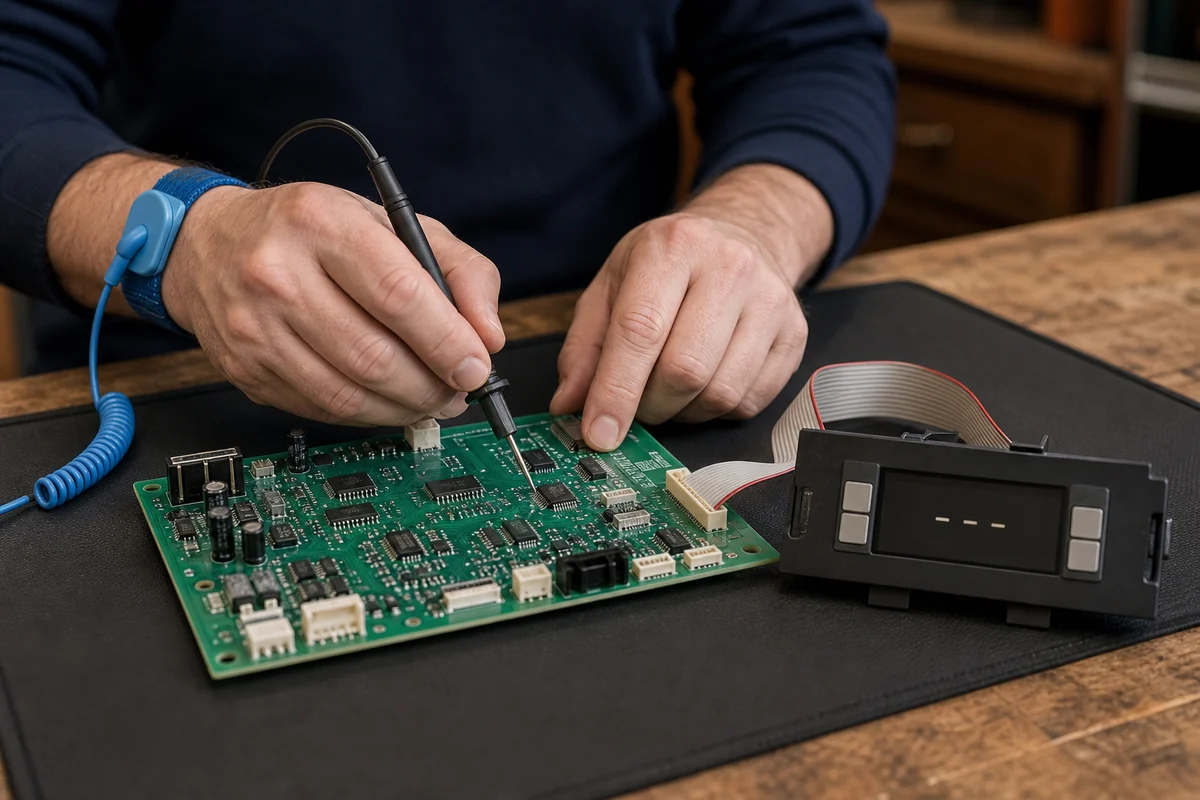
A board is the easy thing to blame and the expensive thing to be wrong about, so we test before we order. Double dashes do point at a failed EEPROM, but a service light can equally be a thermistor reading out of range, and a vacuum condenser message is usually airflow, not electronics at all. We take the readings, match them to the symptom, and only then commit to a part — especially when that part is a scarce, rebuilt-exchange board.
Everything shallower than the board — thermistors, fans, cold controls, condenser cleaning — falls under ordinary refrigerator service and is usually finished the same visit. The vacuum condenser warning has its own diagnosis page if that is the message on your display.
The 600 series, model by model
The badge says 600, but four distinct cabinets wear it, and the differences decide which board, fan, and gasket the job needs. Reading the exact model is the first move on every 600 series call.
| Model | Configuration & years | Most common failure |
|---|---|---|
| 632 | 48-inch side-by-side, 1996–2008 | Control board EEPROM, evaporator fan |
| 642 | 42-inch side-by-side, 1996–2008 | Thermistor drift, board faults |
| 650 | 36-inch over-under, 1996–2008 | Defrost and board electronics |
| 661 | 36-inch bottom-drawer, 2003–2008 | Ice maker solenoid, board, drawer seals |
Because a board or sensor for a 632 may not run a 650 or 661, we cross the model and serial against the vintage roster before quoting. A unit warming the fresh-food side alone gets the same frost read we use on the 561.
What a tech does on a 600 series board call
A board is the easy thing to blame and the expensive thing to be wrong about, so a 600 series electronic complaint runs through a fixed order of proof before any part is ordered.
- Read the display. Double dashes point at the EEPROM; a service light or a vacuum condenser message points elsewhere first.
- Pull the serial. The serial break (before or after #1810000, then the later generations) names which board the cabinet actually takes.
- Check airflow. A vacuum condenser warning is usually a clogged coil — cleaned for $250 to $550 — not a dead board.
- Test the thermistors. A sensor reading out of range throws a service light that looks like a board fault but is not.
- Confirm before ordering. Only when the EEPROM is proven dead do we commit to a board — current stock where it exists, rebuilt exchange where it does not.
The vacuum condenser message gets its own walkthrough on the diagnosis page, and anything shallower than the board is ordinary refrigerator service.
Sub-Zero 600 series questions
My Sub-Zero 600 series shows double dashes instead of a temperature. Why?
Double dashes on the display almost always mean the control board’s EEPROM has failed and the board needs replacement. It is the classic 600 series electronic fault, and it turns up often after a power surge. We test the board to confirm before ordering, because which of the three 600 series generations you have decides whether the part is current stock or a rebuilt exchange.
What is the "vacuum condenser" warning on my 600 series?
On boards built between 1998 and 2002, the vacuum condenser message is the system reporting excessive compressor run time — usually because the condenser coil is clogged and the unit cannot shed heat. Nine times out of ten the fix starts with cleaning the coil. We cover the warning in detail on its own diagnosis page, linked below.
Are parts for the 632, 642, 650, and 661 interchangeable?
Not reliably. The 600 series went through dozens of part revisions, and a board, fan, or sensor for a 632 may not fit a 650 or 661. That is exactly why we read the model and serial number before quoting anything — guessing here is how a unit gets the wrong part and stays broken. Knowing your exact model saves a return visit.
How much does 600 series repair usually cost?
Thermistors, fan motors, cold controls, and most board work land between $550 and $1,100, subject to board availability. A condenser cleaning or minor airflow fix can be $250 to $550. A compressor or sealed-system failure runs higher, $1,000 to $3,000. We confirm a firm written figure after diagnosis, before any work begins.
What is the difference between the 632, 642, 650, and 661?
Width and layout, mainly. The 632 is the 48-inch side-by-side and the 642 the 42-inch; the 650 is the 36-inch over-under and the 661 the 36-inch bottom-drawer that arrived in 2003. They share the 600 series electronics and many failure modes, but boards, fan placements, and some sensors differ by model — which is why we read the plate before ordering rather than treating them as one machine.
My 600 series ice maker quit but the unit still cools — what failed?
On the 600 series an ice maker can throw a fault when the fill solenoid stays energized past about fifteen seconds, often because Jacksonville’s hard water has scaled the valve and slowed the fill. The board reads the long energize as a problem and stops the cycle. We descale and test the valve and solenoid first; a scarce board is the last suspect, not the first.
Why does my 600 series board keep failing after storms?
The voltage spike when power snaps back after a Jacksonville outage does more damage than the dark hours that preceded it, and the 600 series board sits right in the path. Ortega’s older service panels pass that surge straight through. A second board death almost always means the house lacks upstream protection — a whole-home surge unit, roughly $900 to $1,200 fitted, costs less than the board it saves, and we recommend one after a repeat hit.
Bring us the machine everyone else gave up on.
The shop answers Tuesday through Saturday, eight to six. One visit, a straight diagnosis, and a firm number before any work begins.