Repair services · seals
Door Gasket Replacement for Vintage Sub-Zero Units
A refrigerator is only as good as the rubber holding its cold in. On the river, that rubber ages faster than anywhere the catalog planned for.
Sub-Zero® door gaskets in riverfront Ortega harden and split years ahead of their design life — the river’s humidity never lets up. We replace seals on 500, 600, and BI series doors without scarring original panels, typically in the $550 to $1,100 lane with the door trued afterward.
For vintage Sub-Zero repair in Ortega, Avondale, and Riverside, call the shop at (904) 893-3248 or Book online .
Sub-Zero Repair Ortega fits door gaskets for Ortega, Avondale, and Riverside — ZIP 32210 — on a diagnose-first basis. Reach the bench at (904) 893-3248, Tuesday through Saturday, or arrange a visit through our external online booking page.
Updated June 13, 2026.
(904) 893-3248 · Tue–Sat · 8:00 am–6:00 pm · you reach the bench, not a call center
How does a tired gasket announce itself?
Quietly, then expensively. The signs build in roughly this order:
- Sweat or condensation along the cabinet face or between doors
- A compressor that runs noticeably longer each month
- Frost crystals collecting in one corner of the freezer
- A dollar bill that slides out of the closed door with no drag
- A door that drifts open on its own when left ajar an inch
Every one of those symptoms taxes the machine. A leaking seal pulls humid air in around the clock, which means longer compressor runs, iced evaporators, and defrost systems working overtime — wear that lands hardest on machines already in their third or fourth decade. Fresh rubber is the cheapest insurance an old Sub-Zero can buy, which is a point we make at length in our notes on keeping an original unit alive.
| Seal trouble | Test you can run today | Shop remedy |
|---|---|---|
| Bill slides out with no drag | Dollar-bill test on all four sides | New gasket kit, fitted and seated |
| Frost line along one door edge | Look for a flattened or folded corner | Gasket plus door alignment |
| Sweat on the panel front | Feel for cold air at the perimeter | Gasket; mullion heater checked on side-by-sides |
| Door swings itself open | Check the unit’s front-to-back tilt | Leveling and hinge adjustment first |
Why is this climate so hard on seals?
Humidity, all year. The air off the Ortega and St. Johns rivers keeps gasket rubber cycling between damp and dry until it hardens, cracks at the folds, and loses the magnetic grip that pulls the seal home. Houses a century old add their own twist: foundations settle, frames rack a few degrees, and suddenly even good rubber lands out of square against the cabinet.
That is why we true the door as part of every gasket job rather than selling rubber alone. And when a freshly sealed unit still will not hold temperature, the fault sits deeper — the next stop is a full warm-box diagnosis rather than a second gasket.
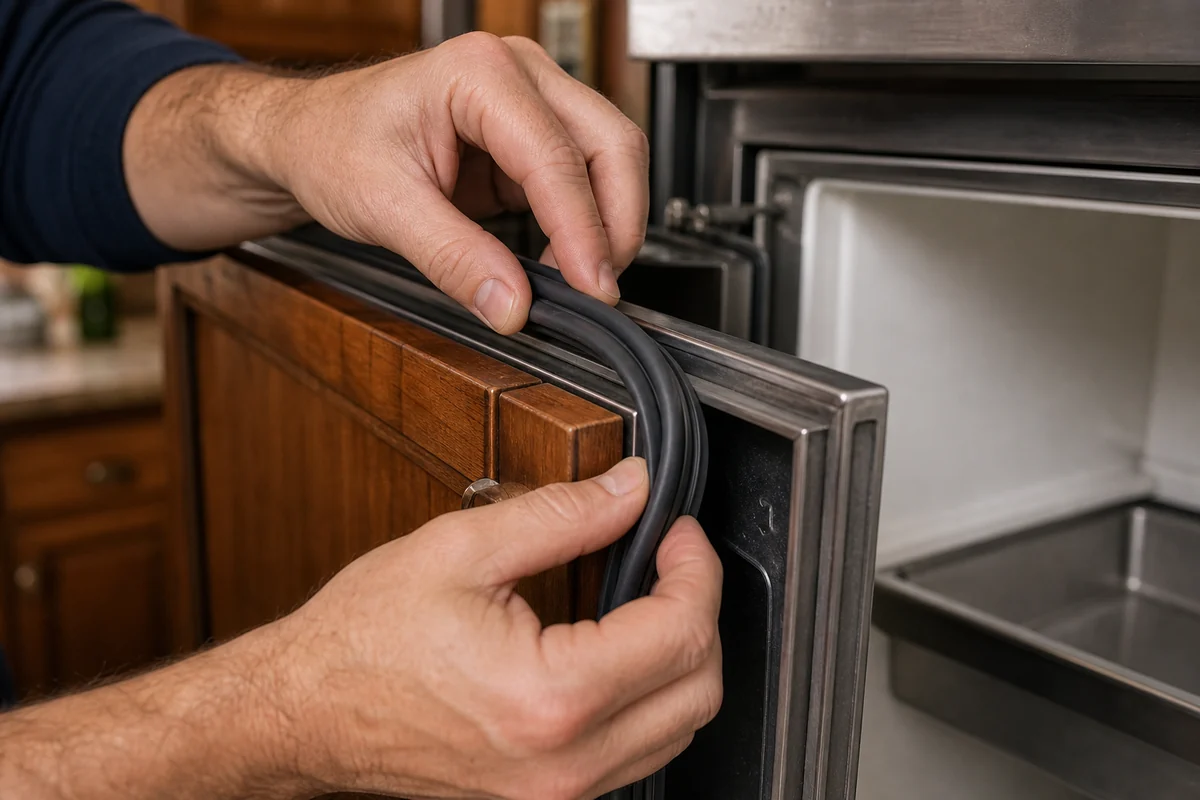
Panel fronts come off whole, not apart
In Ortega Forest and Venetia we regularly work on doors faced in original millwork — wood nobody is going to mill again. The gasket mounts to a retainer behind the panel, so the woodwork is never cut or drilled; it comes off as a unit, waits on a padded blanket, and goes back to the same reveal it held before. On the 500 and 600 series the kits differ by model and year, so we confirm the exact part from the roster of vintage models we support before the visit, not after.
How a gasket job runs from arrival to seated rubber
Fitting a gasket is half the work; making the door close square on it is the other half. A gasket visit on an Ortega or Avondale built-in follows this order.
- Verify the part. The model and serial plate confirm the exact kit before the panel comes off — profiles differ across the 500, 600, 700, and BI series.
- Free the old seal. The retainer screws back off; the panel front, where one is fitted, lifts away whole onto a padded blanket.
- Fit the new gasket. Fresh rubber seats into the retainer, corners worked in first, so the magnetic strip pulls home all the way around.
- True the door. Hinges and leveling get adjusted until the door lands square — a century-old house rarely leaves a frame plumb.
- Prove the seal. The dollar-bill test runs on all four sides before we rehang the panel to its original reveal.
What moves a gasket quote up or down
Most single-door work lands in the $550 to $1,100 lane, but a handful of factors decide where inside it — or whether the job grows beyond a gasket.
| Cost factor | Effect on the quote |
|---|---|
| Number of doors (side-by-side or column pair) | Each door is its own kit and its own fitting |
| Door truing or hinge rebuild needed | Adds labor; common on settled 1920s frames |
| Mullion heater check on a side-by-side | Folds in when sweat is the complaint |
| Custom panel front to remove and rehang | Extra care, no cabinetry damage — same lane |
| Gasket kit scarcity on an older model | Lead time and price track parts availability |
On a multi-unit kitchen — a refrigerator, a freezer column, and a wine cabinet are common on the restored Riverside blocks — we re-seal them in one trip and quote each door so you can stage the work.
Seal questions from around the neighborhood
How can I test a Sub-Zero door gasket at home?
Close the door on a dollar bill and pull. Healthy rubber grips it with a firm drag; a worn seal lets it slide free. Work around all four sides, because gaskets fail at corners first. While you are there, run a hand along the closed edge — any thread of cold air is the same verdict.
What does gasket replacement cost on a vintage unit?
On most built-ins the work lands in the $550 to $1,100 lane per door, parts and labor, including truing the door so the new rubber actually seats. Wide side-by-sides and units needing hinge rebuilds sit at the top of that range. We confirm the figure in writing before starting.
How many years should a gasket last in Jacksonville’s humidity?
Fewer than the catalog suggests. Oceanfront seals can fail in three or four years; here on the river the air is gentler but never dry, and a decade is a good run. We suggest a yearly dollar-bill check each spring, before the cooling season makes a weak seal expensive.
Will replacing a gasket disturb a custom panel front?
No — the panel comes off as one piece or stays on the door entirely, depending on the model. The gasket mounts to a retainer behind it, so the millwork itself is never cut, drilled, or pried. We pad the floor, bag the screws, and rehang everything to its original reveal.
Is a Sub-Zero door gasket the same on every model, or model-specific?
Model and year specific. The retainer profile and corner moldings differ across the 500, 600, 700, and BI series, and a side-by-side uses a different kit per door. We confirm the exact part from your model and serial plate before the visit so the new rubber drops into the right channel and seals on the first fit — guessing a gasket means a second trip.
Can I soften a hardened gasket instead of replacing it?
You can buy a little time — a warm cloth and a thin food-safe silicone can restore some flex for a season. But once river-cycled rubber has cracked at the corners and lost its magnetic pull, softening only delays the inevitable. We will tell you honestly whether yours has a season left in it or needs replacing now.
Why does condensation collect between the two doors on a side-by-side?
That seam holds a mullion heater that keeps the center stile above the dew point. When a gasket leaks or the heater fails, humid Ortega air condenses right there and beads between the doors. We check the mullion heater alongside the gasket on every side-by-side, because new rubber alone will not stop sweat the heater is supposed to prevent.
Bring us the machine everyone else gave up on.
The shop answers Tuesday through Saturday, eight to six. One visit, a straight diagnosis, and a firm number before any work begins.