Repair services · the deep work
Sub-Zero Sealed-System and Compressor Repair
This is the work that decides whether a classic stays in service another decade. Done right, it is invisible. Done wrong, it fails by spring.
When a vintage Sub-Zero® loses its refrigerant charge or its compressor gives out, the repair is sealed-system surgery — recovery, leak repair, evacuation, and recharge. Our Ortega bench rebuilds 500 and 600 series systems for Avondale and Riverside, typically $1,500 to $3,000, against roughly $14,000 to replace the machine outright.
For vintage Sub-Zero repair in Ortega, Avondale, and Riverside, call the shop at (904) 893-3248 or Book online .
Sub-Zero Repair Ortega performs sealed-system and compressor work for Ortega, Avondale, and Riverside — ZIP 32210 — on a diagnose-first basis. Reach the bench at (904) 893-3248, Tuesday through Saturday, or arrange a visit through our external online booking page.
Updated June 13, 2026.
(904) 893-3248 · Tue–Sat · 8:00 am–6:00 pm · you reach the bench, not a call center
What counts as sealed-system work?
The sealed system is the closed refrigerant loop — compressor, condenser, evaporator, heat exchanger, and the lines that join them. Open it and you are no longer swapping a bolt-on part; you are recovering refrigerant, brazing under nitrogen, drying the system under a deep vacuum, and weighing in a fresh charge to the gram. It is the one repair on an old Sub-Zero that a generalist cannot fake, and the reason owners call a specialist.
On the machines we see most, two faults dominate. The first is the 561’s fridge-side evaporator leak, betrayed by that short frost stripe while the fresh-food box never quite arrives. The second is a worn compressor on a unit that runs constantly and never satisfies — usually after years of fighting a blocked condenser.
| Repair path | Proof required first | Cost & timing |
|---|---|---|
| Fridge-side evaporator leak | Short 4–8 in. frost stripe, low side reading low | $1,500–$3,000, multi-stage |
| Compressor replacement | High amp draw, no cooling, electrical checks ruled out | $1,000–$2,000, bench or in-place |
| Heat-exchanger / line repair | Leak located, pressures confirm refrigerant loss | Folds into the rebuild estimate |
| Recharge only (rare) | Leak found and sealed, system proven tight | Lower lane; only after a vacuum holds |
Why we prove the leak before we open the system
A sealed system is not a place to experiment. Adding refrigerant to a unit that is leaking only buys a few weeks and wastes your money, so we locate and confirm the leak first. That means reading the frost pattern, comparing high and low side pressures, and on stubborn cases using an electronic detector along the coil and joints. Only when the evidence is unambiguous do we recover the charge and cut metal.
The rebuild itself follows the same discipline every time: recover, repair, evacuate to a deep vacuum that dries the system and proves it tight, then recharge to the nameplate weight. Skip the vacuum and moisture stays behind to freeze at the metering device; rush the leak check and the new charge walks out the same hole. We do it in order, on the bench where we can see everything.
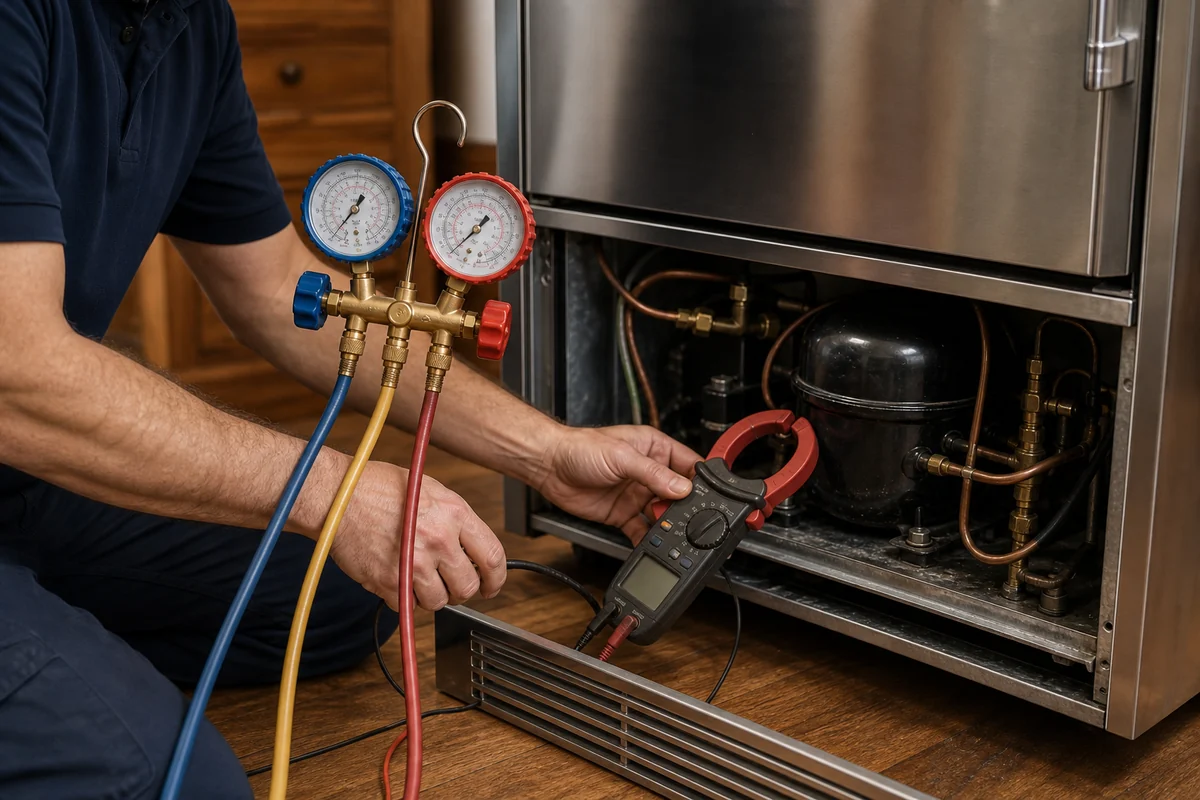
The order of a sealed-system rebuild
- Confirm the leak. Frost pattern, pressures, and a detector pinpoint the failure before any refrigerant is touched.
- Recover the charge. The existing refrigerant comes out into approved recovery equipment — never to the air.
- Repair or replace. The evaporator, heat exchanger, compressor, or line that failed is brazed in under nitrogen.
- Evacuate. A deep vacuum dries the system and proves it holds — the step that separates a lasting repair from a callback.
- Recharge and verify. A fresh charge is weighed in to the nameplate, then the unit runs and settles for a full twenty-four hours before we call it done.
Whether that math favors the rebuild or, occasionally, replacement is the conversation we have in our preservation shop notes — with the real numbers in front of you, not a sales pitch.
Telling sealed-system failure from the cheaper faults it mimics
The symptoms that send owners reaching for the worst-case quote usually have a shallow explanation first. We rule those out before any refrigerant is recovered — here is how each one splits.
| What you notice | Cheaper look-alike | Sealed-system tell |
|---|---|---|
| One compartment warm, the other cold | Stalled evaporator fan or drifting thermistor | Short 4–8 in. frost stripe on the coil |
| Runs nonstop, never satisfied | Clogged condenser starving airflow | High amp draw with airflow already proven clean |
| Slowly losing cold over weeks | Worn door gasket pulling warm air in | Pressures read low, charge confirmed short |
| Frost heavy in one spot only | Defrost heater or thermostat failure | Leak located on the coil, vacuum will not hold |
If the tell on the right is absent, the job is a same-visit refrigerator repair, not sealed-system surgery — and we will say so before quoting the deeper work.
Why a slow leak gets expensive if you wait
A refrigerant leak rarely stays still. As the charge drops, the compressor runs longer and hotter to chase a temperature it can no longer reach, and on Ortega’s old wiring that constant running is its own hazard. A coil leak left for a season can turn a $1,500 evaporator job into a compressor job at the top of the $1,000 to $2,000 lane once the overworked compressor gives out too.
There is a moisture cost as well. A system open to the air, even slowly, lets humidity migrate to the metering device, where it freezes and chokes flow — which is precisely why the rebuild always ends with a deep vacuum to dry it out. Catch the leak while the frost stripe is the only symptom and the repair stays in its smallest, cleanest form. The longer case for keeping a sound cabinet alive is laid out in our preservation shop notes.
Owner questions about sealed-system repair
How do you know a Sub-Zero needs sealed-system work and not just a part?
The frost pattern on the evaporator settles it. Full, even frost across the coil says the refrigerant charge is healthy and the fault lies elsewhere — a fan, a thermistor, a board. A short partial stripe of four to eight inches, with the compressor running hard, is the signature of a leak. We never open a sealed system on a guess; the gauges and the frost have to agree first.
Is it really worth rebuilding the sealed system on a thirty-year-old unit?
Frequently, yes, and the arithmetic is why. A 1990s 532 takes a new evaporator and heat exchanger for around $2,500, against roughly $14,000 to buy and install a modern built-in and alter the cabinetry around it. For a machine hidden behind irreplaceable 1920s panel fronts, the rebuild is usually the rational choice. We walk through that math honestly before you commit.
What does compressor replacement cost on a vintage Sub-Zero?
Plan on $1,000 to $2,000 for a compressor swap, and $1,500 to $3,000 for a full evaporator or sealed-system rebuild. The spread depends on which model, whether the heat exchanger goes with it, and how the unit is built into the cabinetry. You get a firm written figure after diagnosis, never an estimate over the phone.
Do you recover the old refrigerant properly?
Always. The work runs in order: recover the existing charge into approved equipment, repair or replace the leaking component, pull a deep vacuum to dry and prove the system tight, then weigh in a fresh charge to the nameplate. Cutting any of those steps is how a rebuild fails six months later, so we do not cut them.
How long is the refrigerator down for a sealed-system rebuild?
Most rebuilds are a multi-stage job rather than a single afternoon. Recovery, repair, evacuation, and recharge each take time, and the unit then needs a full twenty-four hours to stabilize at its 38 and 0 degree set points. We tell you the realistic timeline up front so you can plan a cooler or a loaner space for the food.
Can you just add refrigerant to a Sub-Zero that is low on charge?
No — a sealed system does not consume refrigerant, so a low charge means a leak, full stop. Topping it off buys a few weeks and wastes your money while the same hole empties it again. We find and seal the leak, prove the system holds a deep vacuum, then weigh in a fresh charge to the nameplate. Anything less is a callback waiting to happen.
Do you braze on the bench or inside the kitchen?
It depends on the fault and the access. A fridge-side evaporator on a 561 or a heat-exchanger repair usually comes to the bench, where we can braze under nitrogen and pull a clean vacuum without a torch near 1920s woodwork. Simpler line work can be done in place with proper heat shielding. We tell you which before the visit so you can plan the kitchen.
Will a rebuilt sealed system be as reliable as a new refrigerator?
On these cabinets, often more so. The 500 and 600 series compressors and steel were built to outlast the kitchens around them, and a properly rebuilt loop — leak sealed, evacuated to a deep vacuum, recharged to weight — runs for years. What you are not buying is a new unit’s thinner cabinet and shorter parts horizon. That trade favors the classic more often than owners expect.
Bring us the machine everyone else gave up on.
The shop answers Tuesday through Saturday, eight to six. One visit, a straight diagnosis, and a firm number before any work begins.