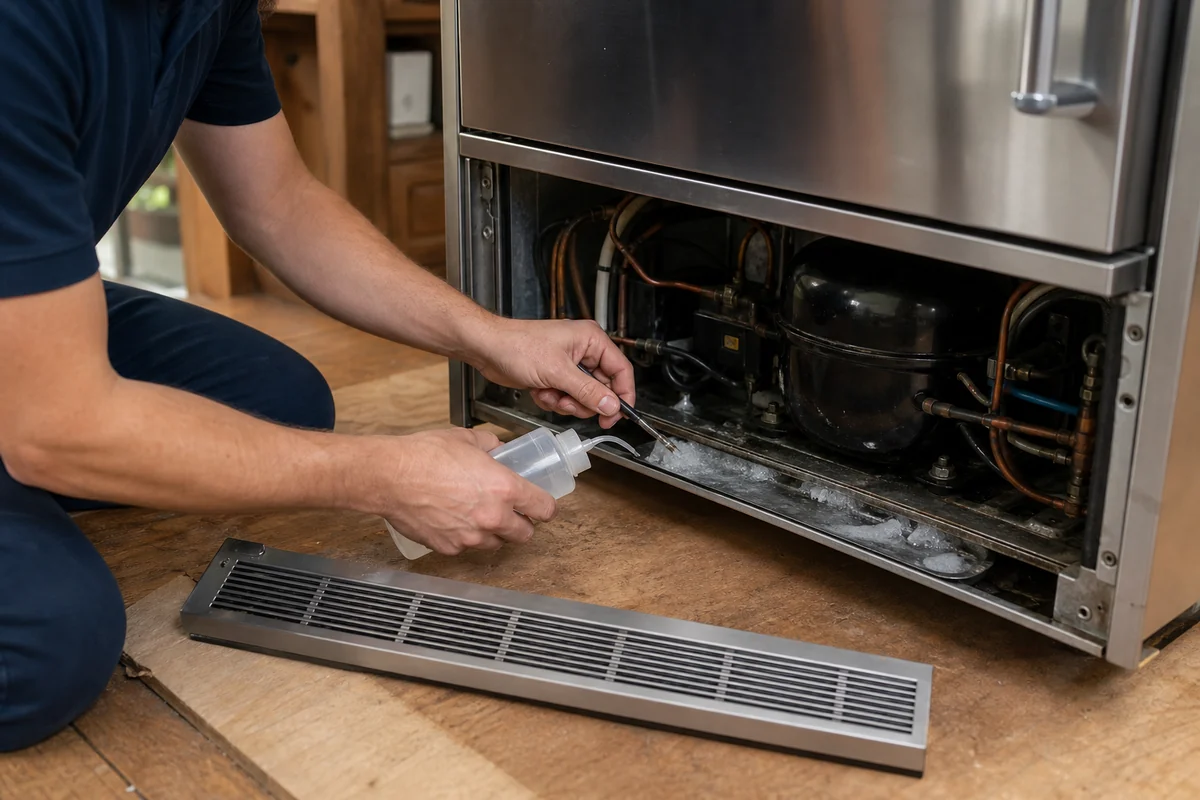
Model 550
The 36-inch over-under, built 1987–1996. Clogged defrost drains and tired cold controls are its usual complaints; after five thousand defrost cycles, an ice sheet under the crispers is almost a rite of passage.
The 550 repair notesAn independent shop · Ortega, Jacksonville
Our bench sits closest to the machines nobody else wants to touch — the over-unders and bottom-mounts that have kept Ortega kitchens cold since the eighties.
Sub-Zero Repair Ortega is an independent shop that repairs and restores vintage Sub-Zero® refrigerators — the 550, 561, and 600 series — throughout Ortega, Avondale, and Riverside. Most legacy repairs land between $550 and $3,000, and a rebuilt sealed system costs a fraction of replacing a built-in and disturbing original 1920s cabinetry.
For vintage Sub-Zero repair in Ortega, Avondale, and Riverside, call the shop at (904) 893-3248 or Book online .
(904) 893-3248 · Tue–Sat · 8:00 am–6:00 pm · you reach the bench, not a call center
Plain answers
Sub-Zero Repair Ortega repairs vintage Sub-Zero® refrigeration — the 550, 561, and 600 series — for Ortega, Avondale, and Riverside, Jacksonville 32210. Reach the bench directly at (904) 893-3248, Tuesday through Saturday, or arrange a visit through our external online booking page.
A diagnostic visit with minor work — coil cleaning, a fan motor — runs $250 to $550, and the call documents the model, the frost pattern, the electrical readings, and a firm written figure before any wrench turns. Most legacy repairs land between $550 and $1,100; see the repair-or-replace arithmetic for the bigger jobs.
We quote a compressor or evaporator only after airflow, electrical, and pressure evidence point there — never on a hunch. Sealed-system rebuilds run $1,500 to $3,000, a fraction of replacing a built-in and disturbing 1920s cabinetry; the deep work lives on our sealed-system page.
Shop facts
Updated June 13, 2026.
The shop’s credo
Sub-Zero made its name on machines meant to outlive the kitchens around them. A 532 from the early nineties can take a new evaporator and heat exchanger for about $2,500 — against roughly $14,000 to buy and install its modern replacement. That math deserves a shop that takes it seriously.
So we stock the gaskets, cold controls, and fan motors these units actually need, and we put our hours into the 500 and 600 series instead of chasing every brand in town. Our shop notes on preserving an original Sub-Zero explain how we decide what is worth saving — and when we will tell you, honestly, that it is not.
On the bench
Three families of machines come through our doors more than all others combined, and each fails in ways we have seen a hundred times before.
The 36-inch over-under, built 1987–1996. Clogged defrost drains and tired cold controls are its usual complaints; after five thousand defrost cycles, an ice sheet under the crispers is almost a rite of passage.
The 550 repair notes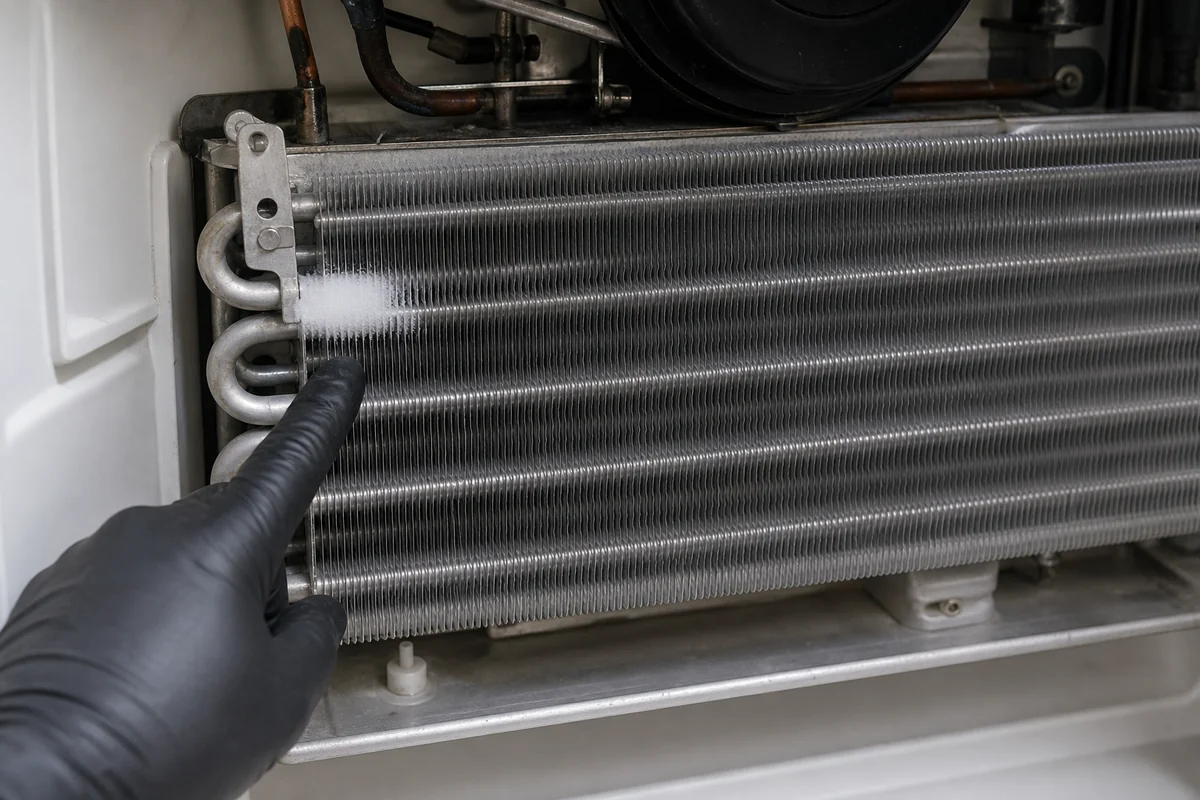
The bottom-mount that ran all the way to 2003. Its known weakness is a fridge-side evaporator leak — a frost stripe only four to eight inches wide tells the story long before a gauge does.
Diagnosing the 561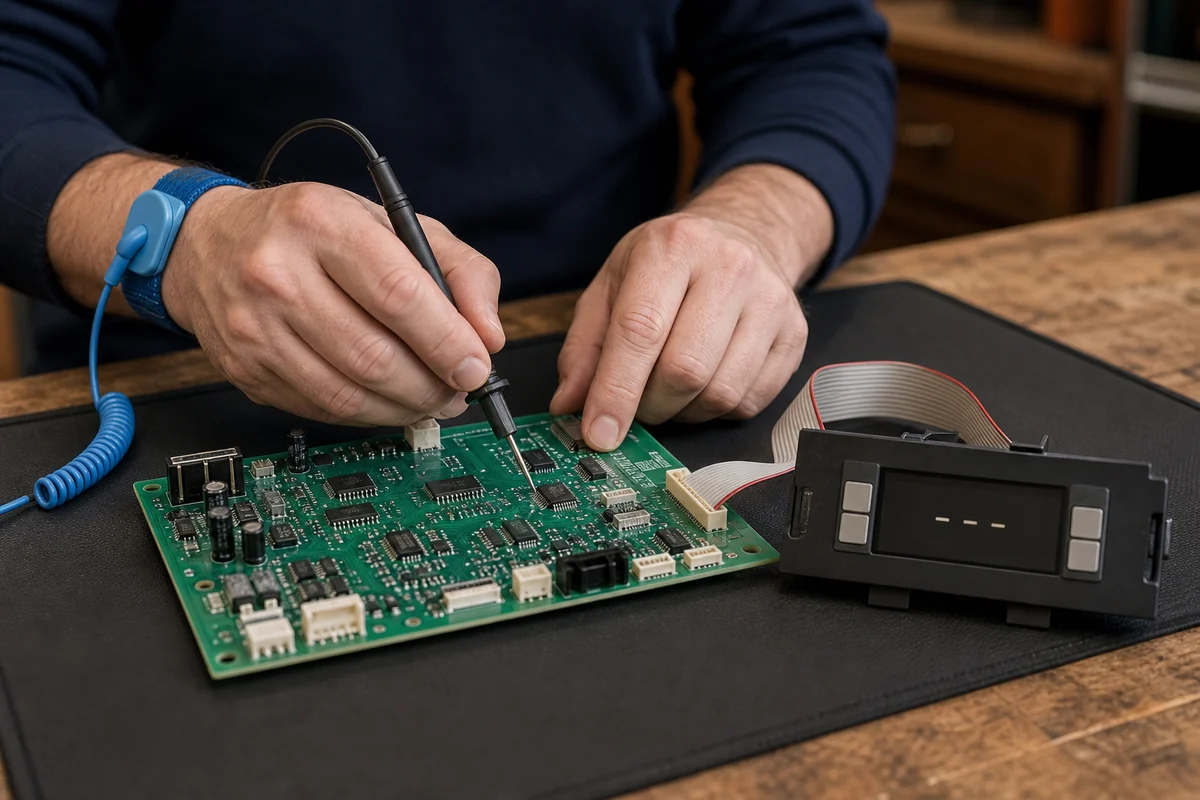
Built 1996–2009 across three electronic generations. Double dashes on the display mean the board’s EEPROM has let go; thermistors and the “vacuum condenser” warning round out the list.
600 series guide| Model | Years built | Most common failure | Typical repair range |
|---|---|---|---|
| 550 | 1987–1996 | Defrost drain icing, worn cold control | $550–$1,100 |
| 561 | 1987–2003 | Fridge-side evaporator (sealed-system) leak | $1,500–$3,000 |
| 600 series | 1996–2009 | Control board EEPROM, thermistors | $550–$1,100 |
| Any vintage unit | — | Compressor replacement | $1,000–$2,000 |
The full roster of machines we service lives on the vintage Sub-Zero page.
Bench and field work
Warm boxes, short-cycling, food freezing against the back wall — our Sub-Zero refrigerator repair service runs the diagnosis from thermistor to compressor.
Jacksonville water runs 14 to 28 grains per gallon — hard enough to choke a fill valve with scale. Ice maker service covers descaling, valves, and solenoid work.
River humidity hardens seals years ahead of schedule. Door gasket replacement restores the chill without scarring a panel front.
Refrigerant leaks and dead compressors call for sealed-system surgery — the deep work that decides whether a classic stays in service another decade.
Step by step
A vintage Sub-Zero earns a real diagnosis, not a guess from the doorway. Here is the order we work in, and why each step comes when it does.
Symptom-specific walk-throughs go further still — start with a compressor that never shuts off or a warm unit in Ortega Forest.
Where we work
Between the river and Roosevelt Boulevard, Ortega’s houses date to the twenties and thirties, and many kitchens still carry their original millwork. A built-in Sub-Zero often hides behind panel fronts matched to cabinetry no one could reproduce today, so we repair in place whenever the fault allows it.
Age brings electrical trouble too. Older panels pass along every spike from Florida’s hundred-plus thunderstorm days a year, and the restoration surge after an outage is a documented killer of control boards. If your unit has hummed without pause since the last storm, start with our note on a compressor that never shuts off.
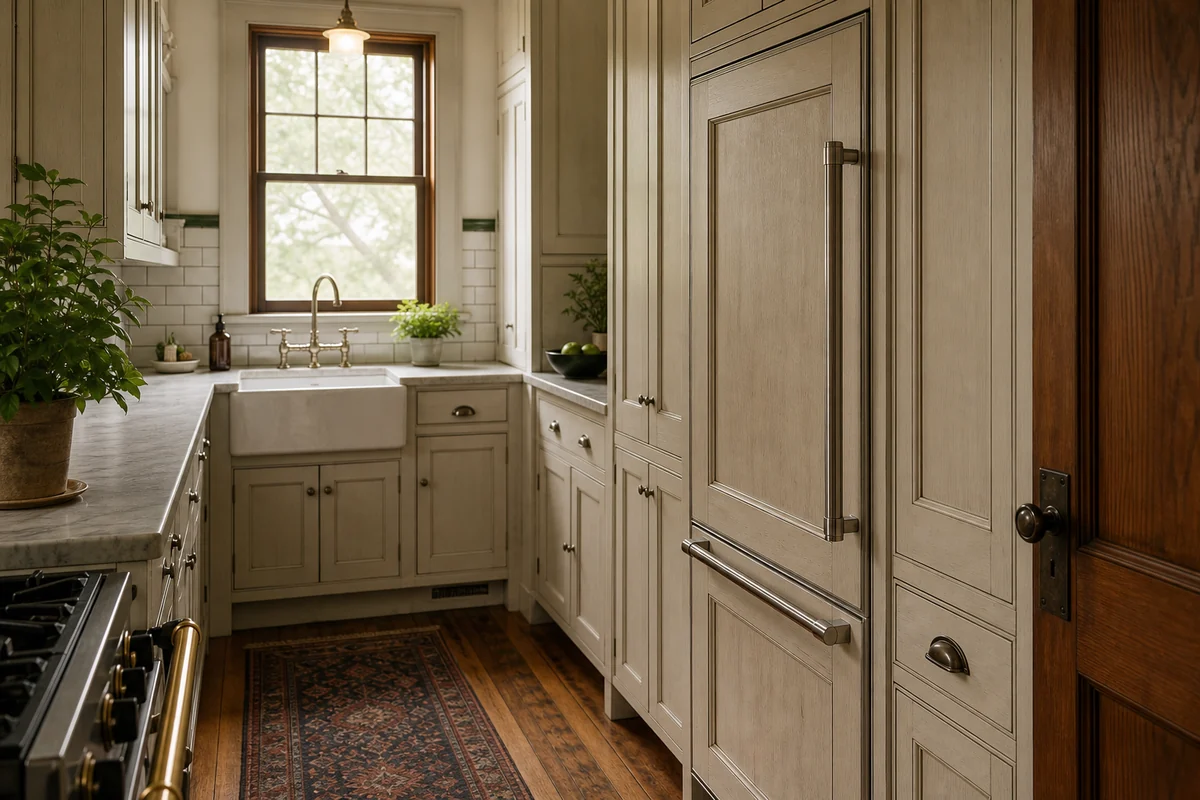
Down the avenue
The same bench serves the blocks around the Shoppes of Avondale and Riverside’s renovated historic houses, where nineties kitchen remodels now run twenty-five-year-old 600 series units.
Gracious old blocks with prized kitchens and very little tolerance for a removal crew. Read about our work in Avondale.
Restored bungalows and luxury retrofits side by side. See what we do in Riverside.
The Ortega climate
Refrigerators on these blocks do not fail at random. The oak canopy, the river, and Florida’s lightning each map to a specific Sub-Zero failure mode, and knowing which one is at work shortens the diagnosis.
| Local force | What it does to the machine | Where it usually lands |
|---|---|---|
| Oak canopy over Ortega Boulevard and McGirts | Pollen and pet hair felt over the condenser; airflow collapses | $250–$550 coil cleaning or fan motor |
| Year-round St. Johns River humidity | Door gaskets harden and shrink years ahead of schedule | $300–$650 gasket replacement |
| 100-plus thunderstorm days, post-outage restoration surge | Voltage spikes 50–100% over nominal scramble 600 series boards | $550–$1,100 board, stock permitting |
| JEA water at 14–28 grains per gallon | Scale chokes ice-maker fill valves and filters | $250–$550 descale and valve work |
The lightning line is the one owners underrate. Northeast Florida draws more cloud-to-ground strikes than anywhere in the country, and the brief surge when power is restored does more board damage than the outage itself. Whole-home surge protection — roughly a $900 to $1,200 install — is honest insurance for a machine you mean to keep, a point we expand in our preservation shop notes.
Straight answers
For most jobs, yes. Door gaskets, cold controls, fan motors, relays, and compatible compressors are still obtainable for the 500 series, and we keep the common pieces on the shelf. The scarce items are certain 600 series control boards, which sometimes exist only as rebuilt exchanges; we confirm availability during diagnosis, before you commit.
Vintage machines are the specialty, but we service out-of-warranty built-ins of any generation, including the BI series. Units from the 2022-and-newer CL and DET generation are usually still under factory warranty, and those owners should call Factory Certified Service first — we will say so on the phone rather than charge for a visit.
Plan on $1,500 to $3,000 for evaporator or full sealed-system rebuilds, and roughly $1,000 to $2,000 for a compressor swap. That sounds substantial until you price a new 48-inch built-in with installation and cabinetry alterations. We quote a firm figure once the frost pattern and pressures tell us what failed.
Our daily rounds run through Ortega, Ortega Forest, and Venetia, then up through Avondale and Riverside — ZIP codes 32210, 32204, and 32205. McGirts Boulevard is minutes from the bench, and Tuesday through Saturday we can usually fold you into a same-week slot.
We make that call from what the fault and the cabinetry allow. A board swap, a fan motor, a thermistor, or a gasket gets done in place behind the panel front. A sealed-system rebuild on a 561 or a compressor on a 600 series often needs the unit on the bench, where recovery, brazing, evacuation, and recharge can be done cleanly. We tell you which before the truck loads.
On a 500 or 600 series the plate sits inside the fresh-food door, usually on the left wall near the hinge. The model number — 550, 561, 632, 650 — tells us the layout; the serial number dates the unit and, on the 600 series, fixes which of the three board generations you have. Reading both to us on the phone lets us carry the right parts to Ortega the first time.
More answers live on the owner questions page.
Bring us the machine everyone else gave up on.
The shop answers Tuesday through Saturday, eight to six. One visit, a straight diagnosis, and a firm number before any work begins.