Neighborhood diagnosis · June 13, 2026
Sub-Zero Not Cooling in Ortega Forest
The Forest’s kitchens hide serious machines behind modest mid-century doors, and when one goes warm the milk does not wait. Here is how these particular blocks fail, and how we get them cold again.
When a Sub-Zero® goes warm in Ortega Forest — the oak-shaded blocks between Roosevelt Boulevard and the Ortega River, ZIP 32210 — the usual culprits are a failed evaporator fan, a control board scrambled by an outage surge, or a tired compressor. We hold same-week bench slots, Tuesday through Saturday.
For vintage Sub-Zero repair in Ortega, Avondale, and Riverside, call the shop at (904) 893-3248 or Book online .
(904) 893-3248 · Tue–Sat · 8:00 am–6:00 pm · you reach the bench, not a call center
Who repairs a warm Sub-Zero in Ortega Forest?
Sub-Zero Repair Ortega repairs vintage Sub-Zero refrigeration throughout Ortega Forest 32210 on a diagnose-first, quote-firm basis — phone the shop at (904) 893-3248 or use our external booking page to arrange a visit. The bench sits minutes away, which matters when a forty-degree refrigerator is climbing a degree an hour.
Why the Forest’s units fail the way they do
Ortega Forest filled in after the war — brick ranches and riverfront houses under a canopy that has been growing since. Most of its kitchens were opened up and re-equipped in the nineties and early two-thousands, which is precisely why so many of them run 600 series machines now deep in their third decade. A handful of original over-unders from the eighties survive too, usually a model 550 still standing its post.
Age would be manageable alone. The Forest adds two accelerants: power that blinks every time a storm moves down the river — with restoration surges running half again over nominal voltage — and a condenser-clogging snow of oak pollen every spring. Boards and airflow, in other words, fail here ahead of the citywide schedule.
Fridge warm, freezer fine — or everything warm?
Refrigerator side warm only
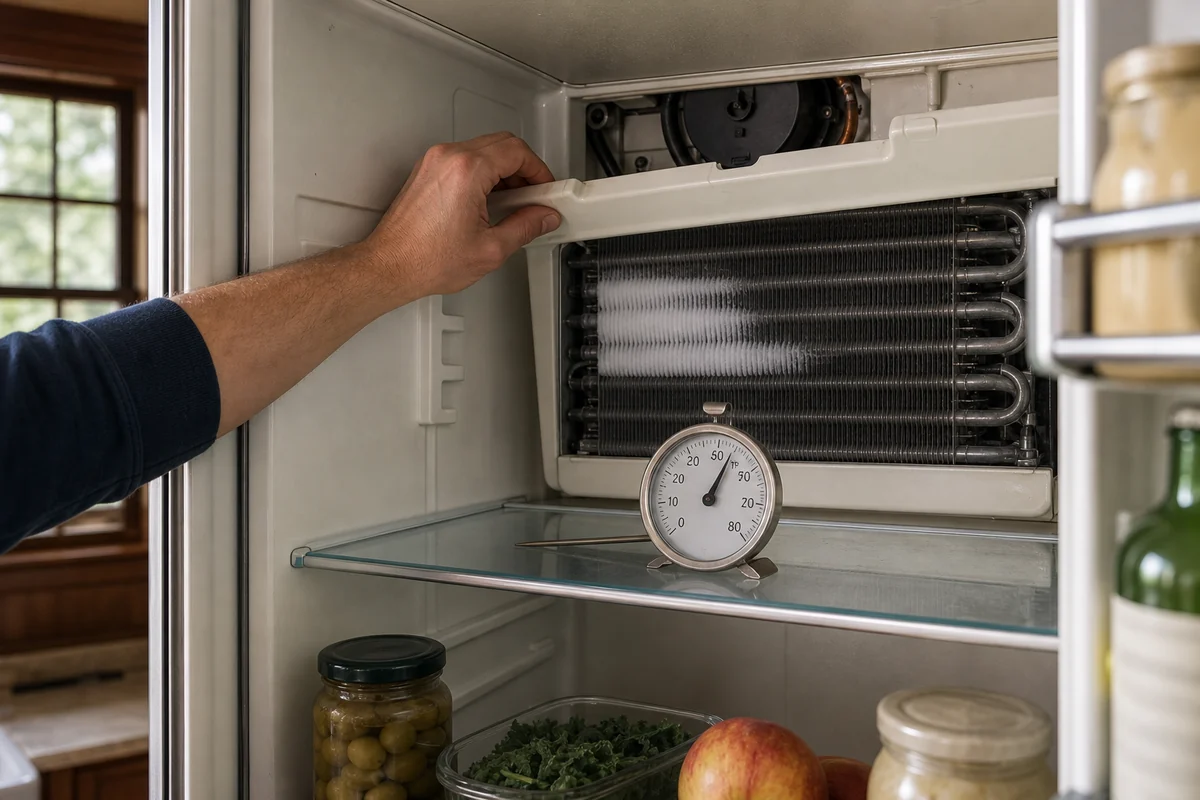
The classic split on over-under and bottom-mount machines. Either the evaporator fan has quit circulating cold, defrost trouble has iced the coil solid, or the fridge-side evaporator is leaking refrigerant — the 561’s well-documented weakness, betrayed by a frost stripe just four to eight inches long.
Both compartments warming
Look to what they share: the condenser, its fan, the compressor, and the board. A unit that runs constantly while losing ground is usually fighting airflow or a failing compressor.
Dead display, or double dashes
Two dashes where the temperature should be means the board’s EEPROM has let go — common on 600 series electronics after a surge, and the first thing we check following an outage on these blocks.
What you see, what we check, what it tends to cost
| What you see | What we check first | Typical lane |
|---|---|---|
| Fridge at 50°F, freezer at 0°F | Evaporator fan, then frost pattern | $250–$550 fan; leak moves it higher |
| Both sides drifting warm over days | Condenser airflow and compressor amp draw | $250–$1,100 |
| Warm after a storm outage, panel dark | Board, fuses, restoration-surge damage | $550–$1,100, board stock permitting |
| Short frost stripe on the evaporator | Sealed-system pressures, leak location | $1,500–$3,000 rebuild |
What a tech does on arrival to a warm Forest unit
A warm refrigerator is a timed problem, so the visit runs in an order that finds the cheap causes before the expensive ones and never wastes a step:
- Thermometer into both compartments, read against 38°F and 0°F — the split between the two sides is the first fork in the road.
- Listen for the evaporator fan inside the cabinet; a silent fan with a warm fridge side and a fine freezer is the most common Forest finding.
- Pull the grille and check the condenser and its fan for the oak-pollen blanket these blocks are famous for.
- Read supply voltage and the board — double dashes or a dark panel after a recent outage point straight at surge damage.
- Lift the evaporator cover last: full even frost clears the sealed system; a four-to-eight-inch stripe condemns it.
- Hand over a firm written figure, then build in the 24-hour stabilization check before calling the box fixed.
The general version of this warm-box workflow, model by model, lives on our refrigerator repair page.
Telling the two warm-fridge causes apart
When the freezer is fine but the refrigerator side is warm, two very different repairs are in play, and the difference between them is the difference between a same-visit fix and a sealed-system decision. Here is how we separate them before any fitting is opened.
| Clue at the machine | Points to a stalled fan | Points to a leak |
|---|---|---|
| Sound inside the cabinet | No fan hum; airflow dead at the vents | Fan audible and moving air normally |
| Evaporator frost pattern | Full, even frost across the coil | Short 4–8 inch stripe, rest of coil bare |
| Repair lane | $250–$550, finished the same visit | $1,500–$3,000 sealed-system rebuild |
The leak case is the 561’s signature failure, and it is exactly where the repair-or-replace math earns its keep.
A case from the Forest — educational diagnostic scenario
An illustration, not a customer record: a bottom-mount 561 off McGirts Boulevard, refrigerator side at 52 degrees, freezer perfect, compressor never resting. The owner had already paid once for a coil cleaning. Pulling the evaporator cover showed frost on barely six inches of coil — the leak signature — so the conversation became a sealed-system decision: a $1,500 to $3,000 repair against the cost and cabinetry surgery of replacing a panel-front built-in. The arithmetic we walk through in our preservation shop notes favored the rebuild, and the machine is back at 38 degrees under its original walnut panel.
Getting a slot in Ortega Forest
Call with the model and serial number from the plate inside the door — it tells us which board generation and which fan motor to carry. Keep the doors closed, shift what matters most into a cooler, and leave the unit running unless it smells electrical. Scheduling details and what to have ready live on the contact and scheduling page.
Forest owners ask
How quickly can the shop reach Ortega Forest when a unit goes warm?
The Forest sits a few minutes from our daily rounds, so a warm refrigerator there usually gets a same-week slot, Tuesday through Saturday. Tell us the model number and what the display shows when you call — it lets us load the right boards, thermistors, and fan motors before the truck crosses Roosevelt Boulevard.
The freezer still freezes but the refrigerator side is warm — what failed?
On the over-under and bottom-mount classics this split points to the refrigerator side specifically: an evaporator fan that quit, a defrost problem icing the coil into a block, or a fridge-side refrigerant leak. The frost pattern decides it — a short four-to-eight-inch stripe on the evaporator is the signature of a leak rather than a fan.
Should I unplug a warm Sub-Zero before the technician arrives?
Leave it running if it is making any cold at all — the behavior we observe on arrival is diagnostic evidence. Do empty the warmest shelves into a cooler and resist opening the doors. If the unit is dead silent and the kitchen smells hot or electrical, then yes, switch it off at the breaker and say so when you call.
Do Ortega Forest power blips really damage these refrigerators?
They do, and the geometry explains it: overhead feeders threading through a heavy oak canopy means more brief outages here than in newer parts of Jacksonville. Each restoration can spike well above nominal voltage for a moment, and aging control boards absorb the hit. After a stormy week we routinely pull two or three surge-struck boards from Forest kitchens.
How warm does the refrigerator get before food is actually unsafe?
The 40-degree line is the one to remember. A Sub-Zero holds the fresh-food box at 38, and anything that has sat above 40 for more than about two hours is in the discard zone for high-risk items — dairy, raw meat, leftovers. The freezer buys far more time; food with ice crystals still present is generally refreezable. When in doubt on a warm Forest unit, move the perishables to a cooler and let us read the rest.
My Ortega Forest unit cools fine for a day, then drifts warm — what causes that?
Intermittent warming usually means a part that works until it heats up or ices over. A defrost fault lets frost build on the evaporator across a day until airflow chokes; a thermistor can drift only at certain temperatures; a marginal relay can drop the compressor after it warms. We catch these by reading the unit through a full cycle rather than a single snapshot, which is why we sometimes return at a different time of day.
Will you need to pull the built-in out of the cabinetry to fix a warm unit?
Often not. Evaporator fans, thermistors, defrost parts, and control boards are reachable from the front in most Forest kitchens, so the unit stays put. We only schedule a controlled pull when the fault is sealed-system — an evaporator or compressor on a 561 or 600 series — where bench access for recovery and brazing is the clean way to do it. Either way we protect the panel front and the original cabinetry.
Bring us the machine everyone else gave up on.
The shop answers Tuesday through Saturday, eight to six. One visit, a straight diagnosis, and a firm number before any work begins.