Our streets · Riverside
Sub-Zero Repair in Riverside, Jacksonville
Restored bungalows and luxury retrofits stand side by side here, and the Sub-Zeros tucked into their old kitchens reward a shop that respects both the machine and the millwork.
Sub-Zero Repair Ortega is an independent Jacksonville shop (32210) that services vintage Sub-Zero® refrigeration across Riverside — ZIP codes 32204 and 32205 — from compact bungalow galleys to gut-renovated historic homes. Call (904) 893-3248 or book through our external page; most Riverside repairs run $550 to $3,000.
For vintage Sub-Zero repair in Ortega, Avondale, and Riverside, call the shop at (904) 893-3248 or Book online .
Updated June 13, 2026.
(904) 893-3248 · Tue–Sat · 8:00 am–6:00 pm · you reach the bench, not a call center
Who repairs Sub-Zero in Riverside?
Sub-Zero Repair Ortega repairs vintage and out-of-warranty Sub-Zero refrigerators throughout Riverside on a diagnose-first, quote-firm basis. Reach the bench directly at (904) 893-3248 Tuesday through Saturday, or arrange a visit through our external booking page. We are an independent shop, not factory service — the people who keep an older built-in running once the warranty is a memory.
Riverside kitchens are a problem of access
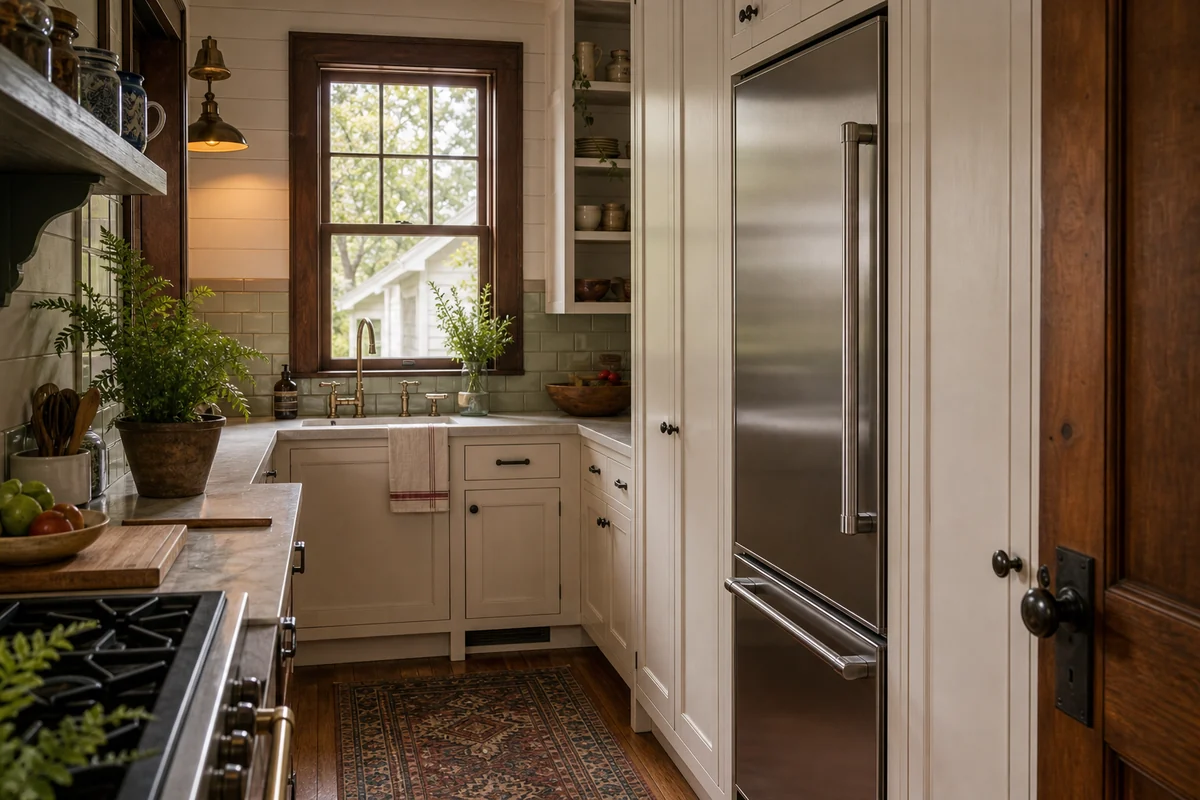
Riverside’s housing stock leans older and tighter than the lots a few blocks south. Bungalows from the 1910s and twenties were never built around a 42-inch built-in, so when a luxury remodel dropped one in, it often landed in a snug recess with barely room to pull the lower grille or fully swing a door. Half of any Riverside service call is figuring out how to get at the hardware without marking the cabinetry or the plaster.
That is the case for a specialist over a generalist. We ask about clearances before we load the truck, bring panel-handling gear and the right dollies, and remove built-ins as whole units when the alcove forces it. The refrigerator repair itself is routine; the careful extraction is the craft.
What fails in a renovated Riverside Sub-Zero
Aging electronics from the remodel era
A gut-renovated historic house usually carries a 600 series unit or an early built-in installed during the remodel — now fifteen to twenty-five years old. Double dashes on the display point to a failed EEPROM, and the vacuum condenser warning haunts the 1998–2002 boards. We test before we replace, because parts in this era are a thicket of revisions.
Humidity, surges, and the river
Year-round St. Johns humidity hardens door gaskets early, and older panels in these houses pass storm spikes straight to the control board. When a unit runs nonstop or goes dark after an outage, we look first at airflow and surge damage — the patterns laid out in our note on a compressor that never shuts off.
Access, evidence, and the service decision
| Kitchen access | What it lets us read | Service decision |
|---|---|---|
| Grille and panels clear, unit pulls forward | Condenser, fan, and full frost pattern in place | Most repairs finished on the first visit |
| Tight recess, door swing limited | Partial access; we plan a controlled pull | Schedule the right gear, often same week |
| Built-in behind matched millwork | Hardware reachable only by removing panels whole | Panels off, labeled, rehung to original reveal |
| Short frost stripe once the evaporator is exposed | Sealed-system leak confirmed by pressures | $1,500–$3,000 rebuild, quoted firm first |
How we plan a tight-galley call before the truck loads
In Riverside the diagnosis is ordinary and the access is the craft, so the planning happens on the phone, not at the curb. Walking through these questions before we leave the bench is what keeps a controlled pull from marking plaster or millwork.
- Model and serial off the door plate. It fixes the board generation and the exact fan or thermistor we carry for a first-visit fix.
- Door swing. Does the unit’s door clear the island or the opposite cabinet, or does it bind at the hinge side?
- Forward clearance. Will the unit roll out at all, or is it foamed and screwed into a recess that demands panel removal?
- Panel fronts. Is it faced in matched millwork that has to come off as a labeled unit and rehang to its original reveal?
- The freight path. Stairs, thresholds, heart-pine floors, or a narrow hall — the route in is planned as carefully as the kitchen itself.
With those answers the right dolly and gear ride along, and the refrigerator repair stays the easy part of the visit.
What fails in a remodel-era Riverside Sub-Zero, part by part
The gut-renovated bungalows that define these blocks share an installed base — 600 series units and early built-ins from the remodel — so the part that fails is fairly predictable once we know the symptom.
| What the owner sees | The part most often behind it | Planning range |
|---|---|---|
| Double dashes on the display | Failed control-board EEPROM | $550–$1,100, board stock permitting |
| Fridge warm, freezer fine, fan silent | Evaporator fan motor | $250–$550 |
| Condensation along the door, sweating seal | Door gasket hardened by river humidity | $300–$650 |
| Runs nonstop after a storm outage | Surge-damaged board or relay | $550–$1,100 |
| Short frost stripe on the evaporator | Sealed-system refrigerant leak | $1,500–$3,000 rebuild |
The humidity-driven seal failure is common enough here to keep its own page — see our notes on door gasket replacement when the door no longer grips.
A Riverside call — educational diagnostic scenario
An illustration, not a customer record: a 642 side-by-side in a restored Park Street bungalow, wedged into a galley with three inches of clearance on either side and a door that would not clear the island. The unit ran constantly and the fridge side was creeping warm. Rather than wrestle it cold, we scheduled a controlled pull with the right dolly, read a full even frost pattern (charge healthy), and found a tired evaporator fan and a coil packed with oak pollen. A $250 to $550 lane, no sealed-system work, and the bungalow’s plaster untouched.
Scheduling a Riverside repair
Call with the model and serial number off the plate inside the door, and tell us about clearances — whether the unit pulls forward, how the door swings, whether it sits behind custom panels. Keep the doors shut, move perishables to a cooler, and leave it running unless it smells electrical. Hours and prep live on the contact and scheduling page; neighbors in Avondale can read the matching notes there.
Riverside owners ask
My Riverside bungalow has a Sub-Zero squeezed into a tight galley — can you still service it?
Yes, and we plan for it before we arrive. Many Riverside kitchens were carved into 1910s and 1920s footprints, so a built-in often sits in a recess with little room to pull the lower grille or swing a door. We bring the right dollies and panel-handling gear, and we ask about clearances on the phone so the truck carries what the alcove demands.
Are the Sub-Zeros in renovated Riverside houses worth repairing?
Usually. A renovated historic house tends to have a 600 series or early built-in installed during the gut-remodel — now fifteen to twenty-five years old and squarely in repair territory rather than replacement. With original cabinetry framing the unit, a $550 to $1,100 board or fan job, or even a $1,500 to $3,000 sealed-system rebuild, beats tearing into custom millwork for a new box.
How is Riverside different from Avondale for appliance work?
They share a river, a tree canopy, and a vintage Sub-Zero population, so the failure modes overlap. The difference is footprint: Riverside has more compact bungalow kitchens and gentrified historic homes where access is the puzzle, while Avondale runs to larger lots. We cover both from the same Ortega bench, Tuesday through Saturday.
Does river humidity in Riverside really shorten gasket life?
It does. Year-round humidity off the St. Johns keeps door seals damp, and the rubber hardens and shrinks years ahead of the schedule a dry climate would allow. The signs are condensation along the door edge and a gasket that no longer grips a slip of paper. A gasket replacement is modest money and frequently ends a constant-running complaint outright.
Can you work around the original electrical in an old Riverside house?
We work with it carefully. Houses from the 1910s and 1920s often still run older panels that pass along every storm spike, and the restoration surge after an outage is a documented cause of 600 series board failure. We test the supply, check for surge damage, and will recommend whole-home surge protection when the wiring warrants it — a roughly $900 to $1,200 install that protects the refrigerator and everything else.
How much clearance does a built-in need before you can pull it forward?
For most 36- and 42-inch built-ins we want the door to swing clear and a few inches at the sides to get hands and a dolly strap on the cabinet — but tighter than that is routine in Riverside, and we plan for it. Tell us on the phone whether the door clears the island and whether the unit sits flush with the counters; that decides which dolly and panel gear ride along, so the alcove never becomes a surprise on the day.
Do you protect plaster walls and original floors during a controlled pull?
Yes — in a 1920s Riverside bungalow the plaster and the heart-pine floors are as irreplaceable as the cabinetry. We lay floor protection along the path, pad the door frames, and move a built-in on the right dolly rather than walking it on its feet. The careful extraction is genuinely half the job here; the refrigerator repair itself is the routine part.
Is the Sub-Zero in my Riverside condo or rowhouse serviceable the same way?
Generally yes, with one wrinkle: shared-wall homes and upper units add a stair or an elevator to the access puzzle, and the freight path matters as much as the kitchen clearance. We ask about both when you call. The diagnosis and the parts are identical to a single-family Riverside house — it is only the route in and out that we plan more carefully.
Bring us the machine everyone else gave up on.
The shop answers Tuesday through Saturday, eight to six. One visit, a straight diagnosis, and a firm number before any work begins.